PLAA Recombinant Monoclonal Antibody
-
中文名稱:PLAA Recombinant Monoclonal Antibody
-
貨號(hào):CSB-RA929118A0HU
-
規(guī)格:¥1320
-
圖片:
-
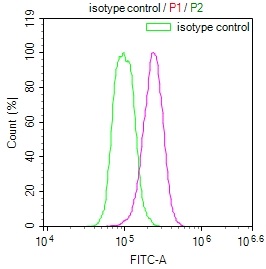
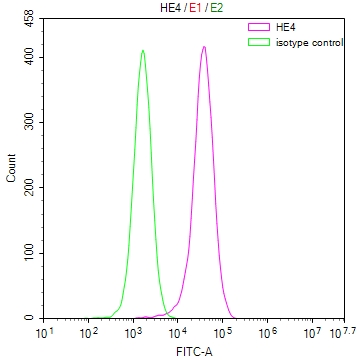
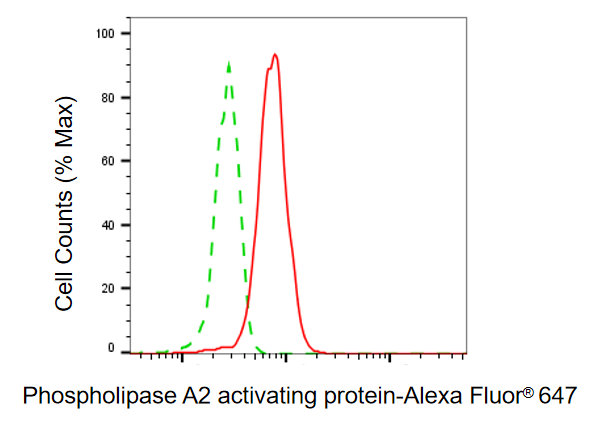 Flow cytometric analysis of phospholipase A2 activating protein expression in HepG2 cells using phospholipase A2 activating protein antibody. Green, isotype control; red, phospholipase A2 activating protein.
 -
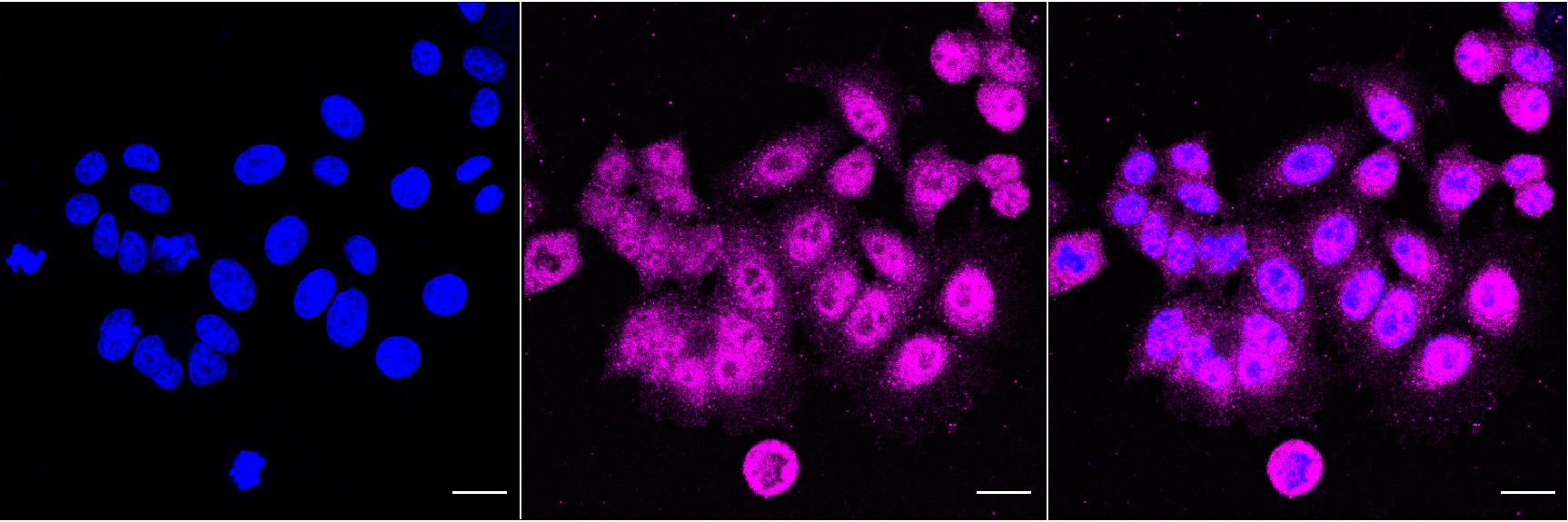 Immunocytochemical staining of HepG2 cells with Phospholipase A2 activating protein antibody. Nuclei were stained blue with DAPI; Phospholipase A2 activating protein was stained magenta with Alexa Fluor? 647. Images were taken using Leica stellaris 5. Protein abundance based on laser Intensity and smart gain: Medium. Scale bar, 20 μm.
 -
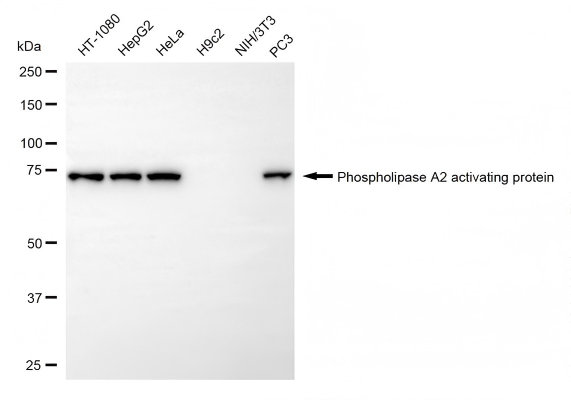 Western blotting analysis using phospholipase A2 activating protein antibody. Total cell lysates (30 μg) from various cell lines were loaded and separated by SDS-PAGE. The blot was incubated with phospholipase A2 activating protein antibody and HRP-conjugated goat anti-rabbit secondary antibody respectively.
-
-
其他:
產(chǎn)品詳情
-
Uniprot No.:
-
基因名:
-
別名:PLAA; Phospholipase A2 Activating Protein; PLA2P; PLAP; DOA1; Phospholipase A-2-Activating Protein; FLJ11281; FLJ12699; DOA1 Homolog (S. Cerevisiae); DOA1 Homolog; NDMSBA
-
反應(yīng)種屬:Human
-
免疫原:Recombinant Human PLAA protein
-
免疫原種屬:Homo sapiens (Human)
-
標(biāo)記方式:Non-conjugated
-
克隆類型:Monoclonal
-
抗體亞型:Rabbit IgG
-
純化方式:Affinity-chromatography
-
克隆號(hào):7B9
-
濃度:It differs from different batches. Please contact us to confirm it.
-
保存緩沖液:Rabbit IgG in PBS (pH 7.4) containing 50% glycerol, and 0.02% sodium azide.
-
產(chǎn)品提供形式:Liquid
-
應(yīng)用范圍:ELISA, WB, FC, ICC
-
推薦稀釋比:
Application Recommended Dilution WB 1:1000-1:5000 FC 1:200-1:2000 ICC 1:100-1:1000 -
Protocols:
-
儲(chǔ)存條件:Upon receipt, store at -20°C or -80°C. Avoid repeated freeze.
-
貨期:Basically, we can dispatch the products out in 1-3 working days after receiving your orders. Delivery time maybe differs from different purchasing way or location, please kindly consult your local distributors for specific delivery time.
-
用途:For Research Use Only. Not for use in diagnostic or therapeutic procedures.
產(chǎn)品評(píng)價(jià)

相關(guān)產(chǎn)品
靶點(diǎn)詳情
-
功能:Plays a role in protein ubiquitination, sorting and degradation through its association with VCP. Involved in ubiquitin-mediated membrane proteins trafficking to late endosomes in an ESCRT-dependent manner, and hence plays a role in synaptic vesicle recycling. May play a role in macroautophagy, regulating for instance the clearance of damaged lysosomes. Plays a role in cerebellar Purkinje cell development. Positively regulates cytosolic and calcium-independent phospholipase A2 activities in a tumor necrosis factor alpha (TNF-alpha)- or lipopolysaccharide (LPS)-dependent manner, and hence prostaglandin E2 biosynthesis.
-
基因功能參考文獻(xiàn):
- In both human and mouse, hypomorphic mutations in the ubiquitin adaptor protein PLAA cause an infantile-lethal neurodysfunction syndrome with seizures. PMID: 28413018
- This study presented that Phospholipase A2-activating protein is associated with a novel form of leukoencephalopathy. PMID: 28007986
- This review provides evidence that 1,25-dihydroxy vitamin D3 stimulates PLA2 via PLAA and CaMKII, a process initiated by Pdia3/PLAA interaction, which further triggers CaMKII-dependent PLA2 activation. [review] PMID: 25448737
- Function assignment to conserved residues in mammalian alkaline phosphatases. PMID: 11937510
- PLAP inhibits sPLA2-triggered release of fatty acids from erythrocyte membranes PMID: 14499668
- identified one stimulatory element, with Sp1 binding sites, and one inhibitory element, in exon 1 of the plaa gene PMID: 18291623
- Structural basis for ubiquitin recognition by a novel domain from the human phospholipase A2-activating protein PMID: 19423704
顯示更多
收起更多
-
相關(guān)疾病:Neurodevelopmental disorder with progressive microcephaly, spasticity, and brain anomalies (NDMSBA)
-
亞細(xì)胞定位:Nucleus. Cytoplasm. Cell junction, synapse.
-
蛋白家族:WD repeat PLAP family
-
數(shù)據(jù)庫(kù)鏈接:
Most popular with customers
-

-
YWHAB Recombinant Monoclonal Antibody
Applications: ELISA, WB, IHC, IF, FC
Species Reactivity: Human, Mouse, Rat
-
-
-
-
-
-